Click here to read this mailing online.

Your email updates, powered by FeedBlitz


P2P Foundation"P2P Foundation" - 4 new articles

  1. Silicon Valley Is Creating ‘The Camera Panopticon’
  2. A true sharing economy requires new equitable forms of ownership
  3. Community Discussion as the Foundation for a New Neighborhood
  4. Reforming Electronic Markets And Trading
  5. More Recent Articles
  6. Search P2P Foundation
  7. Prior Mailing Archive

Silicon Valley Is Creating ‘The Camera Panopticon’

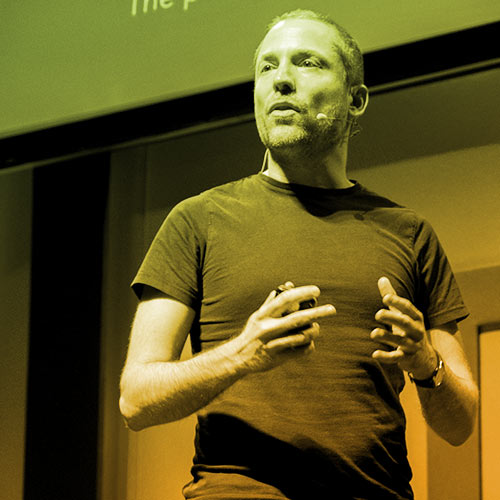
Aral Balkan speaking at a conferenceIn this powerful and indignant article, Aral Balkan – verging on ‘mad as hell and I’m not going to take this any more‘ mode, exposes the nascent total surveillance state, what he calls ‘Spyware 2.0′ and their fraudulent ‘free’ services. He likens the exchange of convenient technology for personal data as tantamount to a theft of one’s soul, and the centralisation of all personal information into private hands as a classic enclosure of the Commons.

When you combine Google’s recent investments in quantum computing, artificial intelligence, and robotics with their existing monopoly in digital services, devices, and connectivity, you get a perfect storm for creating the ultimate surveillance machine; the Camera Panopticon.

The article is given even more weight by the fact that Balkan is ‘walking his talk’ by creating a new mobile phone which he promises will be entirely free of spyware of any variety and will make respect for individual privacy as important as convenience of use. The crowdfunding campaign finishes soon and just needs one final push to be 100% funded.


Read more here.

FacebookTwitterGoogle+RedditShare

The post Silicon Valley Is Creating ‘The Camera Panopticon’ appeared first on P2P Foundation.


A true sharing economy requires new equitable forms of ownership

Léonard and his collaborators are part of a widespread effort to make new kinds of ownership the new norm. There are cooperatives, networks of freelancers, cryptocurrencies, and countless hacks in between. Proposals are being made for a driver-owned Lyft, and Amazon Mechanical Turk workers are scheming to build a crowdsourcing platform they can run themselves. Each idea has its prospects and shortcomings, but together they aspire toward an economy, and an Internet, that is more fully ours.

Excerpted from Nathan Schneider:

“VC-backed sharing economy companies like Airbnb and Uber have caused trouble for legacy industries, but gone is the illusion that they are doing it with actual sharing. Their main contribution to society has been facilitating new kinds of transactions — for a fee, of course, to pay back to their investors. “The sharing economy has become the on-demand economy,” laments Antonin Léonard, co-founder of the Paris-based network OuiShare, which connects sharing-economy entrepreneurs around the world.

The notion that sharing would do away with the need for owning has been one of the mantras of sharing economy promoters. We could share cars, houses, and labor, trusting in the platforms to provide. But it’s becoming clear that ownership matters as much as ever. Whoever owns the platforms that help us share decides who accumulates wealth from them, and how. Rather than giving up on ownership, people are looking for a different way of practicing it. OuiShare, for instance, is starting to prioritize supporting new projects that bake new models of ownership — that is, real sharing — deep into their business model.

Léonard and his collaborators are part of a widespread effort to make new kinds of ownership the new norm. There are cooperatives, networks of freelancers, cryptocurrencies, and countless hacks in between. Proposals are being made for a driver-owned Lyft, and Amazon Mechanical Turk workers are scheming to build a crowdsourcing platform they can run themselves. Each idea has its prospects and shortcomings, but together they aspire toward an economy, and an Internet, that is more fully ours.

“Society needs a new narrative about the world,” Léonard thinks, “and that narrative has to be different from the one Uber is offering.”

One kind of narrative is that a more collaborative, less unequal future will happen almost by itself. Jeremy Rifkin, a futurist to CEOs and governments, contends that the Internet-of-things and 3-D printers are ushering in a “zero marginal cost society” in which the “collaborative commons” will be more competitive than extractive corporations. Investor Brad Burnham of Union Square Ventures has predicted that a new crop of grassroots “skinny platforms” will spell trouble for behemoths like Uber. Sharing economy expert Arun Sundararajan expects that once the VC-backed sharing companies clear away regulatory hurdles, local co-ops will be poised to swoop in and spread the wealth.

These stories are certainly possible, even plausible. But they’re also a bit like expecting Amazon to usher in a renaissance of local bookstores; big companies seeking big profits for the investors who own them tend to get their way in this economy. People are recognizing that doing business differently will require changing who gets to own what.

“We’re moving into a new economic age,” says Marjorie Kelly, who spent two decades at the helm of Business Ethics magazine and now advises social entrepreneurs. “It needs to be sustainable. It needs to be inclusive. And the foundation of what defines an economic age is its form of ownership.”

FacebookTwitterGoogle+RedditShare

The post A true sharing economy requires new equitable forms of ownership appeared first on P2P Foundation.


Community Discussion as the Foundation for a New Neighborhood

By Christopher Alexander. Original text here.

GO OUT AND THINK ABOUT THINGS BY YOURSELF

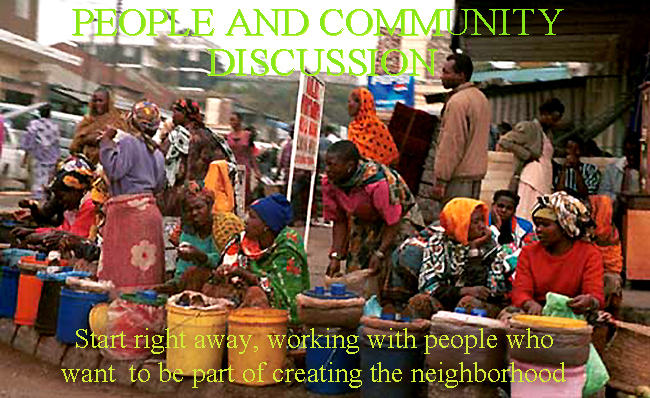
To start with, it’s a good idea to go to the place where you think the neighborhood may be built, just stand there, look around, try to imagine what might happen there, try to draw in whatever inspiration you get from the land. Ask yourself how this idea may work with other people, your friends, your clients, families who may want to live there, small businesses that might like to bring their business to this place.


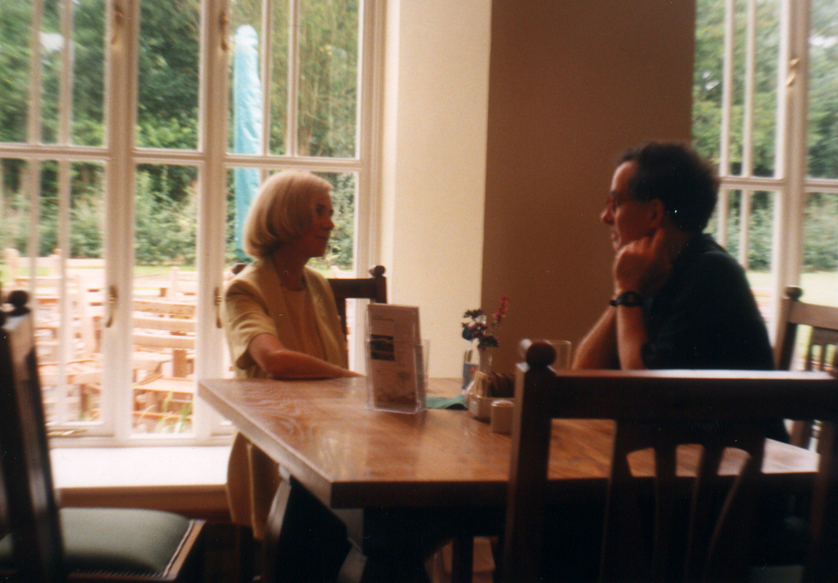
SIT WITH A FRIEND AND TALK IT THROUGH

You cannot do this alone, you can’t even think successfully about it when you are alone.

Innumerable cups of coffee, many meals together, are the ways to get it moving in your minds collectively. Encourage others who are involved to do this as often possible. They will get excited. So will you.


WALK THE LAND TOGETHER

If you go on the land, just for a walk, taking in what is there, getting a feeling for the place, when gradually your group will have a feeling for the land, together. At this stage a communal quality will already be present, because sharing the land, and the feeling for the land, will tend to focus your thoughts in a common direction, without your even making an effort to try and get this to happen.


AS MORE PEOPLE GATHER HAVE MORE DISCUSSION

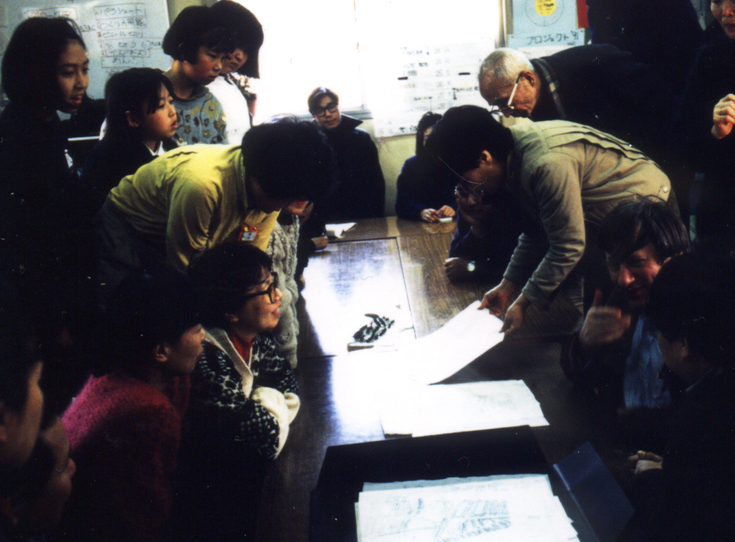
If the group of you has meetings around a table, gradually fruitful discussion will emerge, just from your common knowledge of the land, and a slow sense of common ideals that will emerge, in relation to the land. Look at the animated picture of a group of families working with us in Nagoya, Japan.


LOOK CAREFULLY AT THE LAND TOGETHER, AGAIN

As you can see, in this picture people are just resting together, taking it all in, developing their communal feeling for the place, getting to know it, perhaps getting to know the bushes, or the flowers, or the insects and birds.

It doesnt sound like much, but it makes a big difference.


WORK TOGETHER AND WRITE SOME THINGS DOWN IN YOUR WORKBOOK ABOUT YOUR NEIGHBORHOOD, SO THEY CAN BE BETTER SHARED


SUMMARY OF TASKS FOR THIS UNFOLDING:

  • Think about things yourself.
  • Talk through with a friend.
  • Walk the land.
  • Look carefully at the land again.
  • Write it down!

Looking

Thinking together

Walking the land

Listening

Looking at the land together

Working together

FacebookTwitterGoogle+RedditShare

The post Community Discussion as the Foundation for a New Neighborhood appeared first on P2P Foundation.


Reforming Electronic Markets And Trading

Hazel HendersonArticle by Hazel Henderson

Hazel Henderson organized the Reforming Electronic Markets and Trading seminar.  Author of eleven books and the recent downloadable e-book “Mapping the Global Transition to the Solar Age,”  she is president of Ethical Markets Media, creator of its Green Transition Scoreboard®, co-creator with Calvert of their Quality of Life Indicators (2000) to be updated and re-launched in 2015 and founder of the EthicMark® Awards for Advertising presented annually at the SRI Conference.

Computer-driven financial markets on unregulated electronic exchanges programmed by algorithms now dominate Wall Street, along with high-frequency trading (HFT).  The infamous “Flash Crash” in May 2010, driven by electronic trading, caused stocks in many 401Ks to suddenly fall to pennies and recover in split seconds.  Small investors lost confidence, pulling some $70 billion out of stock markets.

While Wall Street recovered, trust eroded further due to the losses, foreclosures, job cuts and taxpayer bailouts after the 2008 meltdown.  Today, the public’s trust is battered by news of fraud, insider-trading, rigging of interest rates and huge fines on formerly admired banks paid by shareholders and taxpayers instead of indicting financiers.  Regulators in Washington are out-gunned by the faster computers and technology of HFT.  Even market players are sounding alarms.

In 2011, after contacting the SEC, Themis Trading, a respected firm with many pension fund clients went public in Broken Markets, co-authored by principals Sal Arnuk and Joe Saluzzi, alerting all investors to the dangers of electronic front-running and other manipulative practices of HFT and the electronic exchanges on which they trade.  Wall Street Journal reporter Scott Patterson published Dark Pools (2012).  CBS TV’s 60 Minutes covered how Wall Street and global finance was morphing into a complex, unregulated casino.  The public remained suspicious but mystified until Flash Boys by Michael Lewis, a former Wall Streeter, became a global best seller in 2013, explaining in simple terms how “Wall Street is rigged.”

Yet, while regulators were out-gunned, reforming financial markets remains urgent, since markets always perform vital services in all societies as recorded throughout human history and always circumscribed by cultural ethics, rules and regulations.  Today, public and NGO pressure on companies and governments have forced reforms: on tax evasion, cancelling billions of un-repayable debts of poor countries, on safety, pollution control, working conditions, minimum wages and demands for below 1% taxes on all financial transactions, allowed in many countries.  Investors’ movements since the 1970s exclude weapons, tobacco, alcohol, pollution, unfair working conditions, excessive executive pay.  Campaigns for human rights through divestment ended apartheid in South Africa and recent efforts shift assets from fossil fuels to cleaner, renewable energy.  All have reformed and continue to transform finance along with all the new metrics forcing formerly “externalized” social costs back on to financial balance sheets.

Today’s agenda is to reform electronic markets and trading, since all the progress by investors in shaping more responsible corporate and financial practices can be undermined if the markets’ underlying plumbing and structure remain unsound.  Today’s broken markets are subject to new manipulations and misuse of computers and electronic platforms resting on global communications infrastructure: satellites, the internet, fiber optics, the electromagnetic spectrum – all public goods funded by taxpayers.

To advance reform, Ethical Markets convened a key group of experts in New York City, Nov. 3, 2014, to assure more stable market structures, restore confidence and prevent the next market crash that many believe is inevitable. Each participant submitted a prior statement of their views and reforms they favored.  We covered a wide range of proposals, many already aired in Congressional hearings by the Senate Committee on Finance and chair Carl Levin (D-MI), with testimony by Brad Katsuyama, CEO of IEX (“hero” of Michael Lewis’ Flash Boys) and Dave Lauer, CEO of KOR Trading, both at our seminar.

Continue reading the full article – http://www.csrwire.com/blog/posts/1464-reforming-electronic-markets-and-trading

FacebookTwitterGoogle+RedditShare

The post Reforming Electronic Markets And Trading appeared first on P2P Foundation.


More Recent Articles


Click here to safely unsubscribe from "P2P Foundation." Click here to view mailing archives, here to change your preferences, or here to subscribePrivacy

Email subscriptions powered by FeedBlitz, LLC, 365 Boston Post Rd, Suite 123, Sudbury, MA 01776, USA.