
Click here to read this mailing online.
Here are the latest updates for ignoble.experiment@arconati.us
| ||||||||||||


Which AI tools do small businesses use? 2026 surveyNearly 3 in 4 small business owners who use AI (73%) now run their business on more than one AI tool. We surveyed 187 American small business owners who use AI, most of them running a business of one, to find out which tool they reach for when they write an email, design a logo, or plan next quarter’s budget, and why they switch between them. What came back was a toolbox. ChatGPT was the default for every job we asked about, but owners kept a second or third tool for the work it didn’t do as well, and the ones who handed AI the most tasks got the most time back. Here’s what else they told us. Key takeaways
Most owners run their business on more than one AI toolFew owners set out to build an AI stack. They picked up a second tool the first time the first one fell short, and they kept it.  Nearly 3 in 4 small business owners who use AI (73%) ran more than one AI tool in the past three months, and about 1 in 4 (27%) ran four or more. ChatGPT sat at the center of nearly every toolbox: 82% had used it, and about half (51%) called it the tool they use most. Gemini was the clear runner-up, used by 64% and named the go-to by about 1 in 4 (24%), followed by Claude (29%), Canva AI (24%), Microsoft Copilot (22%), and Meta AI (18%). Owners weren’t switching for the sake of it. Nearly 2 in 3 of those who run more than one tool (62%) said some tools are better at certain tasks, close to half (46%) said different tools have different personalities or writing styles, nearly 2 in 5 (39%) compared answers across tools to double-check them, and more than 1 in 4 (28%) said they hit usage limits on free plans. That habit grew with the toolbox: 3 in 5 owners using four or more tools (61%) cross-checked answers, more than double the share of those using two or three (26%). Owners with a small team were more likely than solo owners to run several tools (82% vs. 65%). The payoff showed up in what owners reported. More than half (55%) said using more than one AI tool got them better results than relying on one, rising to 3 in 4 (76%) of those using four or more, versus about 1 in 10 single-tool owners (12%). The juggling still has a cost owners would pay to avoid: more than 2 in 5 (43%) said they would pay more for one AI tool that did everything well, and nearly 3 in 5 of those using four or more tools (59%) agreed. One in 3 owners (33%) went further, saying AI lets their business compete with larger companies, a share that rose to 43% among those using four or more tools and 44% of owners who launched with AI. Where AI earns its keep, task by taskAsk owners which jobs they hand to AI, and the list is long. The time owners report saving depends on how much of that list they hand over.  Brainstorming topped the list, with nearly 9 in 10 owners (87%) using AI for it, followed by research (80%) and generating images or graphics (73%). Marketing copy (67%), emails (66%), and social media content (64%) weren’t far behind. At the other end, fewer than half used AI for customer service (47%) or bookkeeping and invoicing (43%), the least of any task. ChatGPT was the top pick for all 10 tasks we asked about, yet it never won more than half of owners for any single one. Its biggest share was brainstorming, at 49%. Reported time savings tracked with how much owners handed over. Among all owners, AI saved:
The gap was wider among owners who used AI for more tasks. Those who used AI for eight or more of the 10 tasks were six times as likely to save a big chunk of time as those who used it for four or fewer: 48% saved six or more hours a week, compared with just 8%. These figures are what owners reported, and show a pattern rather than a guaranteed result. The tasks where owners most often reported saving time were the ones they were least likely to try. Owners who used AI on their website were more than four times as likely to report saving six or more hours a week as those who didn’t (43% vs. 10%), and customer service (43%) and bookkeeping (41%) followed close behind. Owners most often said they couldn’t run their business the same without AI tools for generating images (35%), brainstorming (29%), and research (28%). Businesses built with AI, and the agent gap that remainsA lot of these businesses were built with AI from the start, they used AI to name the company, design the logo, and write their first marketing materials. But ask owners about AI agents, the tool everyone in tech is talking about, and most draw a blank.  Among owners who use AI, nearly 3 in 5 whose business started in the past three years (58%) were launched with help from AI. Founders put it to work on the basics first:
Half of owners whose business is three years old or younger were very comfortable with AI, compared with 31% of those in business for 11 years or more. Overall, about 3 in 4 owners (76%) were comfortable using AI for their business. The website is where AI has become routine. More than 1 in 5 small business owners (22%) still didn’t have a website, and the gap tracked with the amount of AI they used. Owners who used just one AI tool were the most likely to go without a website (42%), while only 12% of those using four or more didn’t have a site. Among owners with a site, 45% had used AI to write product or service descriptions, 44% to write or edit copy, 41% to generate images, 28% to improve search rankings, and 16% to build the site itself with an AI website builder. AI agents are another story. Nearly 1 in 3 owners (31%) said they’d used one, but far fewer could say what one is. When we asked owners to describe an AI agent in their own words, two-thirds (66%) described a chatbot, an assistant, or a search tool, and another 3% weren’t sure. Only about 1 in 3 (32%) described what sets an agent apart: that it takes action or completes tasks on its own, not just answers questions. Even among owners who said they’d used an agent, fewer than 2 in 5 (38%) could describe one accurately. Usage climbed with the toolbox, with more than 2 in 5 owners using four or more tools (45%) having tried one, versus 1 in 10 single-tool owners (10%). Agent usage climbed with the toolbox. More than 2 in 5 owners (45%) using four or more tools had used an AI agent, while just 10% of single-tool owners had. Trust, but check the workOwners were careful with what AI handed back: 67% checked AI’s work rather than trusting it outright, and only about 1 in 10 (12%) worried their business was becoming too dependent on it. About a third (34%) said AI had replaced work they would otherwise have hired someone to do, rising to 46% among owners with a small team. What this means for small business ownersIf there’s one thing to take from all of this, it’s that small business owners aren’t waiting for one perfect AI tool. They’ve built a toolbox: a default for most jobs, a specialist or two for the rest, and a habit of checking the work. The owners who got the most time back were the ones who handed over the most, including the jobs most people still do by hand, like the website, customer service, and the books. For an owner still doing everything themselves, the first step isn’t finding the best tool. It’s picking one job, handing it over, and see how much time they report getting back. Our guide to using AI for business growth is a good place to start. MethodologyThis survey was conducted online in September 2026 by Fractl on behalf of Network Solutions. It surveyed 187 American small business owners who use AI tools for their business to explore which tool they reach for, task by task, why they switch between them, how AI figured into starting their business, and how it shows up on their websites. All participants were adults aged 18 or older, owned or operated a business, and had used at least one AI tool for it in the past three months. For this study, a small business was defined as an independently owned business with 50 or fewer employees, including sole proprietors and solopreneurs who operate on their own. The average age of respondents was 44, and the typical business had been operating for six years with a team of one, the owner. Of those surveyed, 66% were women, 31% were men, and 3% were non-binary. By generation, 10% were baby boomers, 27% were Gen X, 55% were millennials, and 9% were Gen Z. By business size, 57% were solo owners, 30% had 2 to 5 employees, and 13% had 6 to 50. By age of business, 32% had been operating for three years or less, 41% for 4 to 10 years, and 27% for 11 years or more, and 78% had a business website. By sector, the largest groups were retail or eCommerce, health and wellness, and professional services. Owners who use more than one AI tool are the 73% who used two or more of the listed tools in the past three months, with 46% using two or three and 27% using four or more. Owners who launched with AI are the 27% of all respondents who used AI tools somewhat or extensively when starting their business; among businesses started in the past three years, that share rises to 58%. Another 32% started their business before these tools were available. Open-ended descriptions of an AI agent were coded by Fractl against the survey’s definition of an agent as an AI that completes multi-step tasks or takes action on its own. Breakdowns for subgroups smaller than 25 respondents are noted as directional. Methodology percentages not totaling 100% are due to rounding. The margin of error is approximately ±7.2 percentage points at a 95% confidence level. All findings are self-reported and do not guarantee results. About Network SolutionsFor over 40 years, we have helped people claim their space online, and we’re still evolving right alongside the internet we grew up with. From domains and hosting to website building, security, and AI tools built to help you move from idea to action faster, we bring everything you need to grow into one place. We believe you have what it takes to break through, and we’re here to help make it happen. Fair use statementInformation in this article may be used for noncommercial purposes only. If you reference any findings, please provide a link back to this page and a mention of Network Solutions as the author. Product names mentioned are trademarks of their respective owners. Their inclusion reflects survey responses and does not imply any affiliation, sponsorship, or endorsement. The post Which AI tools do small businesses use? 2026 survey appeared first on Network Solutions Blog.     Website habits of hyper growth solopreneursRunning a business of one means being the founder, the marketing team, the bookkeeper, and the help desk all at once. So we wanted to know what the hyper-growth solopreneurs do that others might not. We surveyed 193 solo business owners and zeroed in on the hyper-growth group, those whose revenue grew 30% or more in the past year, to see which website and digital habits show up most among them. The pattern was clear among hyper-growth solopreneurs. They get their business online early, keep improving their website after launch, and hand over routine tasks to AI so they can focus on the work that grows the business. Key takeaways
Hyper-growth solopreneurs get websites up early and keep at itFor the hyper-growth solopreneurs, a website isn’t a someday project. It’s a part of their operations. 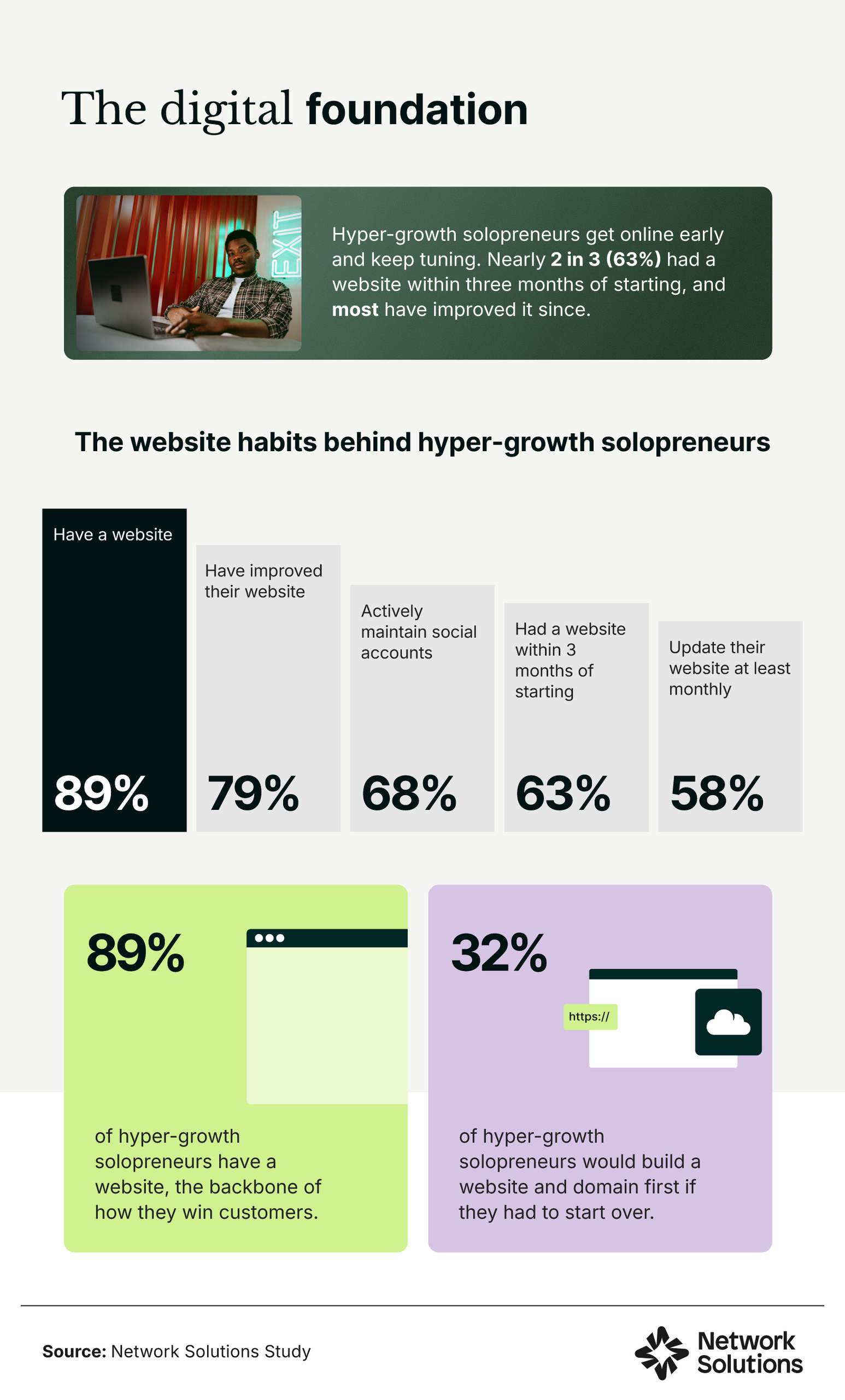 Nearly 9 in 10 hyper-growth solopreneurs (89%) had a website, and most got there fast, with 63% online within three months of starting, compared with 40% of other solopreneurs. Just as telling is what they did after launch. More than 3 in 4 (79%) had improved their website since building it, versus 63% of the rest, and 58% updated it at least monthly, compared with 39%. More than 2 in 3 (68%) also kept active social accounts. When we asked all solopreneurs what they would build first if they had to start over, more than 1 in 4 (27%) said a website and domain, second only to their personal network. Even so, about 1 in 4 solopreneurs overall (24%) still had no website, a reminder of how much room there is to catch up. AI is the team they never hiredAsk a hyper-growth solopreneur how they cover the work of a full team, and the answer is usually AI. 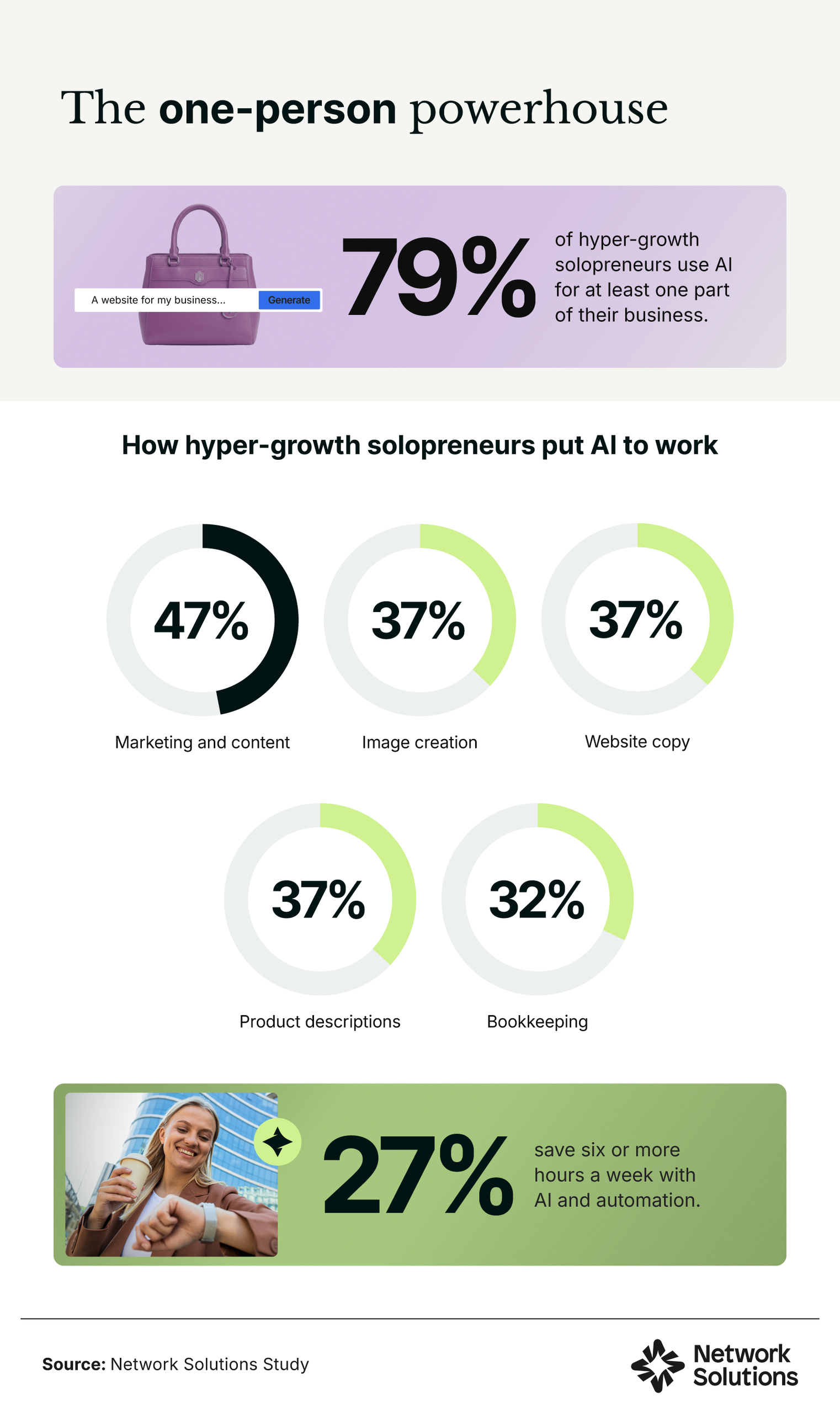 Nearly 4 in 5 hyper-growth solopreneurs (79%) used AI for at least one part of their business, compared with 64% of other solopreneurs. Marketing and content led the way at 47%, versus 30% of the rest, followed by image creation and website copywriting (both at 37%). About a third (32%) used AI tools to help with their bookkeeping, compared with 13% of other solopreneurs, and 26% used AI to support marketing or social media work. More than 1 in 4 hyper-growth solopreneurs who use AI (27%) saved six or more hours a week, and 1 in 10 saved more than a full workday. Across all solopreneurs, product descriptions, marketing and content, and images were the most common uses, each named by about 3 in 10. Still, 35% of solopreneurs don’t use AI at all, the single most common answer when we asked how they use it, so there’s a clear opening for the ones who start.. How hyper-growth solopreneurs achieve successGet the foundation and the tools right, and a business of one starts to feel a lot bigger. 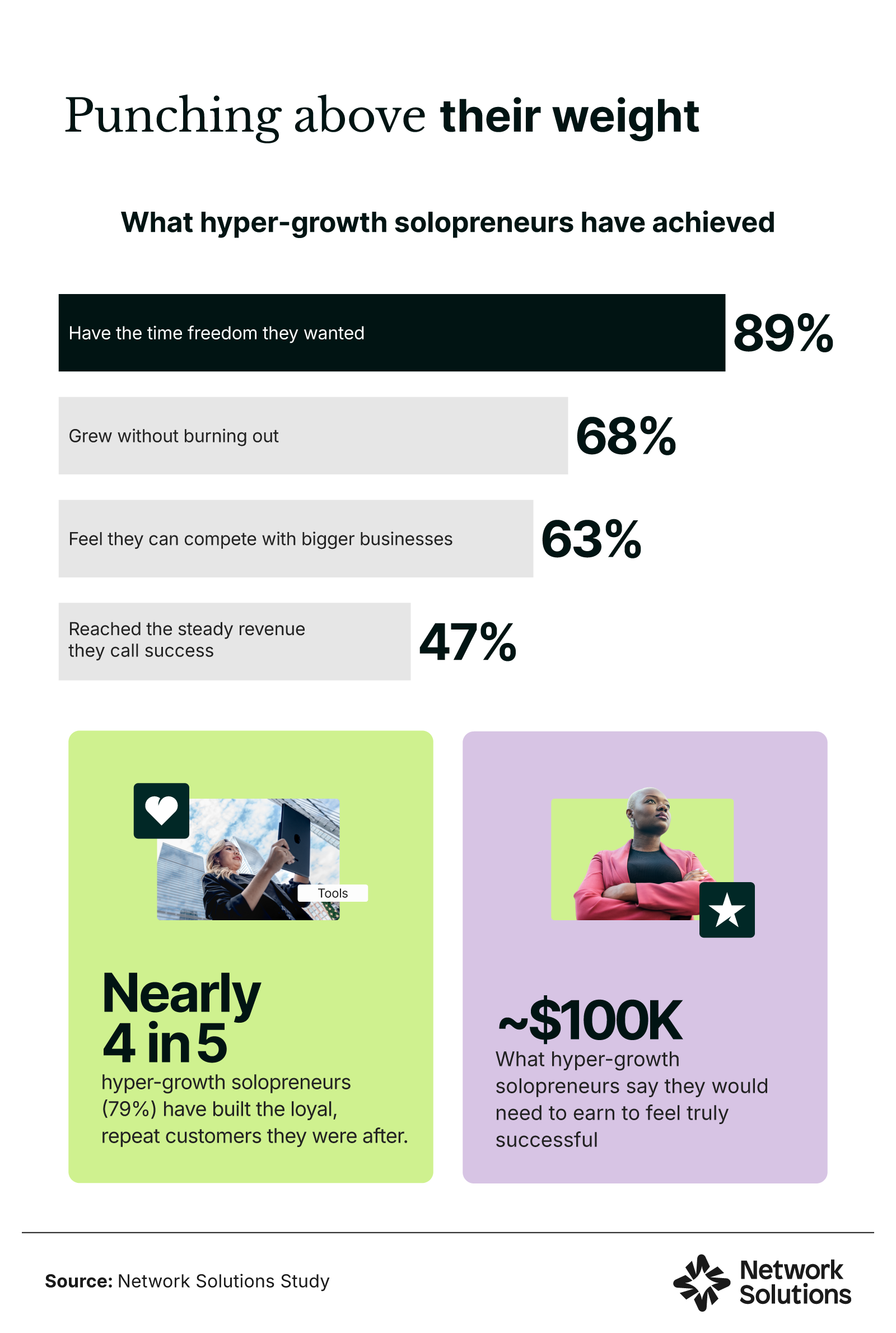 Nearly 9 in 10 hyper-growth solopreneurs (89%) had the time freedom they set out for, compared with 68% of other solopreneurs, and 63% felt their tools let them compete with far bigger businesses, versus 40% of the rest. More than 2 in 3 (68%) said they had grown without burning out, more than double the 31% of other solopreneurs, and 47% had reached the steady, reliable revenue they define as success, compared with 30%. Across all solopreneurs, steady revenue was the top definition of success, cited by 79%, yet only 31% had reached it. Overall, solopreneurs said they would need about $78,000 a year to feel successful, while 62% currently earn under $50,000. Hyper-growth solopreneurs set an even higher bar, at about $100,000, and they were the likeliest to be closing the gap. What this means if you are building soloIf there’s one thing to take from all of this, it’s that the hyper-growth solopreneurs aren’t working with more people or having more luck. They get online early, keep their website running, and let AI handle the busywork so their time goes to the work only they can do. You don’t need a team to grow. You need a foundation you keep building on, and the right tools to stand in for the team you haven’t hired yet. MethodologyThis survey was conducted in August 2026 by Fractl on behalf of Network Solutions. It surveyed 193 American solopreneurs to explore what it takes to grow a business of one, from how quickly they built their online foundation to which websites and digital habits, including AI, they rely on to run everything themselves. Hyper-growth solopreneurs are those whose annual revenue grew 30% or more over the past year, approximately 10% of respondents. Other solopreneurs are all remaining respondents. This report compares the two groups to surface the habits most common among the fastest-growing solopreneurs. All participants were adults aged 18 or older and were the sole owner or operator of their business. The average age of respondents was 43. Of those surveyed, 63% were women, 30% were men, and 8% self-described, preferred not to say, or did not disclose. By generation, 7% were baby boomers, 30% were Gen X, 51% were millennials, and 12% were Gen Z; a further 5% did not disclose their age. Methodology percentages not totaling 100% are due to rounding. The margin of error for the full sample is approximately ±7 percentage points at a 95% confidence level. Hyper-growth figures are based on a subgroup of 19 respondents and are directional, with a wider margin of approximately ±22 percentage points. All findings are self-reported and do not guarantee results. About Network SolutionsFor over 40 years, Network Solutions has helped people claim their space online, and it all starts with a domain. As this study shows, many solopreneurs still don’t have a website, and the ones growing fastest treat getting online as step one. From registering your domain to website building, hosting, security, and AI tools built to help you move from idea to action faster, we bring everything you need to get online and grow, all in one place. Ready to claim yours? Start your domain search at Network Solutions. We believe you have what it takes to break through, and we’re here to help make it happen. . Fair Use StatementInformation in this article may be used for noncommercial purposes only. If you reference any findings, please provide a link back to this page and a mention of Network Solutions as the author. The post Website habits of hyper growth solopreneurs appeared first on Network Solutions Blog.   The impact of website downtime on entrepreneursFor small businesses, the website is often the storefront, the cash register, and the help desk all at once. So when it goes dark, a lot of the business goes with it. We surveyed 201 American small business owners, most running businesses with fewer than 10 employees and many a team of one, to find out how often their websites fail, what those failures cost, and how ready they are for the next one. The picture that came back shows owners who wear every hat, fix the site themselves when it breaks, and dig into lost sales, all while betting that their site will always be working. Most of the time it does. The trouble starts on the day it doesn’t. Key takeaways
The cost of going darkThe damage from a downed website rarely arrives as one dramatic event. It shows up as sales that quietly never happen.  Websites are the backbone of many small businesses. Nearly 2 in 5 (38%) told us their business wouldn’t survive a full week without a working website, or they weren’t sure it would. Half of retail and eCommerce owners (50%) said their business wouldn’t survive a week offline, the highest of any sector we measured. About 1 in 3 small-business owners (32%) have lost a sale, order, booking, or lead due to a website problem. Owners with 2 to 10 employees were more than twice as likely as solo owners to have lost one (51% vs. 22%). The losses sometimes happened out of sight, with nearly 1 in 4 small business owners (24%) losing sales or leads before they noticed anything was wrong with their website. And 1 in 5 (20%) knew a customer abandoned a purchase when the checkout or payment page failed. For more than 1 in 4 owners (26%), the worst outage meant going completely dark for a full day or longer. When we asked what an hour of downtime during their busiest season would cost, nearly 1 in 10 (9%) said a single hour would run them $500 or more. To put that in perspective, the typical business in this study brings in about $50,000 a year, or roughly $960 in a given week. For an owner at that level, losing $500 to a single hour of downtime is more than half a week’s revenue gone. Belief vs. reality: how long will a visitor really wait?Owners tend to assume they have time. Nearly 3 in 4 (73%) think a visitor will wait three seconds or longer for a page to load before leaving. Shoppers are less forgiving than that. In a separate Network Solutions online shopping study, nearly 1 in 5 shoppers (19%) said they would wait only three to five seconds for a page to load, and just 27% were willing to give it six to 10 seconds. For an owner betting on a visitor’s patience, that gap is the difference between a sale and a bounce. The one-person IT departmentWhen something breaks, most owners don’t call anyone. They fix it themselves, or they wait.  Nearly 3 in 5 owners (59%) handle website problems entirely on their own, with no outside help, a share that climbs to nearly 7 in 10 (69%) among solo owners. They are the detection system, too. More than 2 in 5 (45%) said they noticed their most recent problem themselves, while just 12% heard about it from a customer and 3% didn’t catch it for a while. Being the whole IT department has its limits. When we asked how fast they could get a downed site back online, about half of small business owners (49%) figured an hour or two, but 15% admitted they wouldn’t know where to start. The strain lands hardest on owners with a small team. More than 3 in 4 of those with 2-10 employees (78%) said they feel stressed or anxious when their website goes down, compared to less than half of solo owners (48%). The costs aren’t only emotional. More than 2 in 5 owners (42%) have paid out of pocket to fix website problems in the past year, and nearly 1 in 5 of them (18%) spent more than $500. The damage can also outlast the outage: 1 in 5 (20%) have lost a customer to a competitor due to a website issue, and 15% have watched their reputation take a hit. One bad afternoon awayMost small businesses are one bad afternoon away from an outage they are not ready for.  The safeguards that keep a website online are the exception, not the rule, among small-business owners. Only about 1 in 3 owners have security or malware protection (36%) or regular backups (34%) in place. Fewer have someone on call, a service agreement with their hosting provider, or uptime monitoring. All told, 32% have no specific protection for their website, and 82% have no uptime monitoring, meaning there’s no alert when their site goes down. That leaves many owners exposed to events well beyond their control. Professional services owners were the least protected of any sector, with 42% reporting that nothing was in place to guard their site. Only 1 in 4 (25%) said they were very confident their website would stay online through a major cloud outage; 60% were only somewhat confident, and the rest were not confident at all. If the worst did happen, nearly 2 in 5 (38%) said they would need a full day or more to recover, or wouldn’t know where to start. None of this workload is what owners expected when they started. More than 1 in 4 (28%) said keeping a website running reliably is harder than they thought it would be, rising to 45% among those with a small team of 2 to 10 employees. What website downtime means for your businessIf there’s one thing to take from all of this, it’s that a website isn’t a set-it-and-forget-it purchase. It’s infrastructure that requires regular maintenance, monitoring and safeguards in place for when the unexpected happens.The businesses who come through an outage best aren’t necessarily the most technical. They’re the ones who decided in advance how they would know when something broke and have a plan for how they would get back online. A backup, an alert, and a simple plan for who fixes what can turn a lost week into a lost hour, and that part is worth the afternoon it takes to set up. For owners who want a place to start, our guide to preventing website downtime walks through the safeguards that make the biggest difference. MethodologyThis survey was conducted in August 2026 by Fractl on behalf of Network Solutions. It surveyed 201 American small business owners to explore how often their websites fail and what those failures cost, from the sales lost during an outage to how prepared they are for the next one. All participants were adults aged 18 or older and owned or operated a business with a website. For this study, a small business was defined as an independently owned business with 50 or fewer employees, including sole proprietors and solopreneurs who operate on their own. The average age of respondents was 43, and the typical business reported about $50,000 in annual revenue. Of those surveyed, 65% were women, 32% were men, and 3% self-described, preferred not to say, or did not disclose. By generation, 5% were baby boomers, 34% were Gen X, 51% were millennials, and 9% were Gen Z; a further 1% did not disclose their age. By business size, 70% were solo owners, 24% had 2 to 10 employees, and 5% had 11 to 50. By sector, the largest groups were creative, marketing, or media; retail or eCommerce, and professional services. Breakdowns for subgroups smaller than 25 respondents are noted as directional. Methodology percentages not totaling 100% are due to rounding. The margin of error is approximately ±6.9 percentage points at a 95% confidence level. All findings are self-reported and do not guarantee results. About Network SolutionsFor over 40 years, we have helped people claim their space online, and we’re still evolving right alongside the internet we grew up with. From domains and hosting to website building, security, and AI tools built to help you move from idea to action faster, we bring everything you need to grow into one place. We believe you have what it takes to break through, and we’re here to help make it happen. Fair Use StatementInformation in this article may be used for noncommercial purposes only. If you reference any findings, please provide a link back to this page and a mention of Network Solutions as the author. The post The impact of website downtime on entrepreneurs appeared first on Network Solutions Blog.   The AI side hustle boomAbout a quarter of U.S. adults reported having a side hustle in 2025, according to Bankrate. We surveyed 1,007 Americans with an active side hustle, a business they run for extra money outside their main job, to see how AI is changing the way they build it. Two findings jumped out. AI is pulling people off the sidelines who might not have started at all, and those who use AI report earning more than those who don’t. But there’s still limitations to consider, which the data doesn’t hide. Key takeaways
How AI is helping side hustlers launchFor most of the people we surveyed, the hardest part was never the work itself. It was the blank page or not knowing where to begin.  One in 5 side hustlers (20%) told us that they wouldn’t have started their business without AI tools. Add the ones who weren’t sure they would’ve gone through with starting without AI, and the share climbs to 1 in 3 (33%). Digital product sellers leaned on AI the most (48%) to get going, followed by freelancers (40%), while local service providers needed it the least (17%) to get started. Why people struggle to start a side hustleWhen we asked side hustlers to name the single biggest barrier that used to stop them from starting, the top answer was not knowing where to begin (36%), well ahead of cost (18%) and time (17%). That uncertainty was the top barrier for every group we looked at, from part-timers and resellers (both 44%) to every generation, from Gen Z to baby boomers. Money mattered more to the youngest, though: 21% of Gen Z named cost as their biggest hurdle, nearly double the 12% of baby boomers who said the same. Time to launch and earningsAI didn’t turn launching into an overnight affair, but it did tend to beat expectations. People who used AI were more likely than those who didn’t to say getting started went faster than they’d thought (38% vs. 30%). Those building toward a primary income (44%) were more likely to say the launch beat expectations, next to 38% of income supplementers and 27% of hobbyists. The timeline backs it up. Most side hustlers had a live website up within 1 to 3 months, and more than 1 in 3 (37%) did it inside a month, a figure that rose to 42% of resellers and, surprisingly, 47% of baby boomers, ahead of Gen Z (39%), millennials (35%), and Gen X (37%). Then comes the moment that actually counts: the first dollar. More than 1 in 2 side hustlers (55%) earned their first dollar within 30 days of launching. Resellers got there fastest (64%), with freelancers close behind (59%), which makes sense given both can start selling the day they set up shop. The tasks side hustlers hand to AISo what exactly are side hustlers using AI for? Mostly writing, whether that’s website copy, product descriptions, or social posts. But that’s not the whole picture.  Copy and product descriptions topped the individual list at 44%, with social content close behind at 37%. Resellers (56%) and online store owners (50%) leaned on AI copywriting the most, while content creators used it the least (34%). When we asked which type of tool actually worked best, nearly half (49%) named general AI assistants over any specialized design app or website builder. The unemployed leaned on them hardest (69%), with the self-employed close behind (58%). The payoff people felt most was time. Among the 810 side hustlers who use AI, the average person said it saves them about nine hours a week, which adds up to nearly 12 standard workweeks over a year. Those building toward a full-time income saved around 11 hours a week, and digital product sellers about 12. Has AI replaced workers?For most people, AI hasn’t replaced a person so much as replaced the slow way of doing things. Many (61%) said that before AI, they would have done the work themselves, just far more slowly, a pattern that held steady across every generation. Only 1 in 10 (10%) said they’d have paid a freelancer or agency for work they now hand to AI. And for 35%, AI replaced nobody at all, because there was never going to be a hire in the first place. Where it did step into a role, it was most often the graphic designer’s (14%), followed by a marketing agency (12%). The through line is execution, not strategy. AI handles the busywork while the side hustler still makes the calls. Where the payoff shows up, and where it stopsSaving time and saving on the freelancer bill is one thing. What all of it adds up to is another, and it’s the question every side hustler eventually reaches: Does any of this actually make money?  Side hustlers who use AI reported earning about $555 per month, compared with about $333 for those who don’t use AI. In median terms, that’s $500 versus $250, a clean doubling. The catch is that people who reach for new tools early tend to be the more serious, more full-time crowd to begin with, so read this as a strong correlation, not a promise that AI on its own fills the till. Differences in side hustler earnings by demographicThe earnings story really comes down to how seriously people take the work. Hobbyists averaged about $286 a month. People using the hustle to supplement a paycheck did far better, around $700, and those building toward a full-time income landed near $589. Heavier AI use tracked with higher numbers, too, with regular users averaging in the low $600s per month. Age and stability told the same story. Earnings climbed steadily with age, from about $428 per month for Gen Z to $635 per month for baby boomers. And the people with a steady base under them earned the most. Full-time employees running a hustle on the side averaged about $593 a month, well ahead of part-timers ($373) and the unemployed ($271). What side hustlers still struggle withWhat AI couldn’t fix may say the most. The hardest thing to hand off, side hustlers told us, wasn’t technical at all. It was staying motivated (28%), and that struggle grew with age, from 22% of Gen Z up through millennials and Gen X (both 29%) to 37% of baby boomers. Finding and keeping customers came next (20%), highest among the unemployed (28%) and content creators (26%). And a quieter worry ran underneath it all. Nearly 1 in 2 (45%) said they fear AI makes it easier for a competitor to copy what they do, a concern felt most by digital product sellers (52%) and content creators (50%). What this means if you’re just starting outIf there’s one thing to take from all this, it’s that AI has knocked down a lot of the excuses people used to lean on for not starting a side hustle. Hand it a rough concept, and it’ll draft your business plan, name the brand, or map out a social campaign, so you’re not frozen in front of a blank screen. What it won’t do is care whether your hustle actually works. That part is still yours. Staying with it through a dead month, reading what your customers really want, turning a one-time buyer into a regular who tells their friends, those come down to strategy and grit, and no model has either. AI runs the busywork. You still run the business. Which is the whole point of having the right tools in your corner. When the busywork of getting a site live and keeping it running is handled for you, from the domain to the design to the day-to-day upkeep, you get to put your energy where it counts, into building something people come back to. That’s the part worth protecting. MethodologyThis Network Solutions survey was conducted online in August 2026 by Fractl on behalf of Network Solutions. It questioned 1,007 American adults with an active side hustle, defined as a business or gig they run for extra income outside their main job, to explore how AI tools are changing the way people start and run one. All participants were adults aged 18 or older, and the margin of error is approximately ±3.1 percentage points at a 95% confidence level. The average age of respondents was 38. Of those surveyed, 50% were women, 49% were men, and 1% self-described or preferred not to say. By generation, 25% were Gen Z, 49% were millennials, 20% were Gen X, and 5% were baby boomers. Percentages not totaling 100% are due to rounding. At times in this report, respondents were grouped by the role their side hustle income plays, as follows:
AI users are the 810 respondents (81%) who said they use AI tools for at least some of their work, and non-users are the 197 (19%) who reported not using AI at all. Earnings are self-reported monthly figures, shown as trimmed averages that exclude statistical outliers, and reflect AI use in general rather than any specific product. Comparisons between AI users and non-users show association, not causation, since the two groups differ in other ways, including how full-time they are. All findings are self-reported and are not a guarantee of results. About Network SolutionsFor over 40 years, Network Solutions has helped businesses claim their space online, and we’re still evolving right alongside the internet we grew up with. From domains and hosting to website building and security, we bring everything you need to grow into one place, now supercharged with AI tools built to help you move from idea to action faster. We believe you have what it takes to break through, and we’re here to help make it happen. Fair Use StatementInformation in this article may be used for noncommercial purposes only. If you reference any findings, please provide a link back to this page and a mention of Network Solutions as the author. The post The AI side hustle boom appeared first on Network Solutions Blog.   More Recent Articles
|